Anyways, enjoy (or not): http://thinkprogress.org/climate/2013/05/07/1972581/99-one-liners-rebutting-denier-talking-points-with-links-to-the-full-climate-science/
Environ...Mental. Basically, that means crazy about (environment) or approximately crazy, right? French environ + slang use of word 'mental'.
Wednesday, December 18, 2013
99 One-Liners Rebutting Denier Talking Points
Anyways, enjoy (or not): http://thinkprogress.org/climate/2013/05/07/1972581/99-one-liners-rebutting-denier-talking-points-with-links-to-the-full-climate-science/
Tuesday, November 5, 2013
Economy of Humans and the Amsterdam Urban Innovation Week
Got it from: Economy of Humans, here.
The economy-of-humans requires but a single step: to see ourselves reflected in others. We no longer buy in to the myth of the individual, which owes her fortune to a unique combination of talent and sweat. We see and value the merits of our shared culture, the people that raised and surround us, the bold inventions of people we do not know. We no longer value products over people, and some occupations, backgrounds and accents over others. We realise that humble, selfless contributions to the whole will make us the finest, most happy human beings.As we went up the heavens and looked back, we suddenly saw how fragile and small our habitat is. We saw our planet with its tiny habitable landmass, sustaining life to seven billion inhabitants amidst a universe of emptiness, with boundless dimensions and unimaginable timescales. Our presence unnoticed, our struggles unheard. This blue planet that sustains and confines us, binds all of us into a species of earth-dwellers, far more common to each-other than to anything else in the entire universe. We are in this trip together.
The economy-of-humans only demands a different perspective. It doesn’t cost money, and nobody will get rich. It’s immune to financial bubbles, stagflation or even scarcity. It is as familiar to us as anything can be. And it is winning us over, one by one, at an ever-increasing pace. It might take some courage, but the gains are without borders. By taking care of, and value the others, we value, and take care of ourselves.
(This article was first published in publication 'Redefining Growth - a collection of stories on shifting values' by PICNIC during the Amsterdam Urban Innovation Week. This book was designed and made in one day by 20 participants of The Book Fab Lab on Sept19th, 2013 - edited by Michiel Jansen-Dings. It comes with a choice of 14 different covers.)
Monday, September 23, 2013
How does one transform massive suffering into X% GDP?
Author addresses key issues and drawbacks of the infamous Stern Review (2006). It's quite a read and does provide a nice example of how everything, every single paper, books, newsitem, ..., should be put under close scrutiny and checked for consistency and truth. (Which, with the lack of time of a single individual, can be nigh impossible.)
Below, an excerpt. Still below, the source.
"The surprises are potential scenarios which scientists can outline to the best of their ability and
which involve loss of life and human infrastructure on a grand scale; losses only precedented by the mass movement of people, death and destruction of World War II.
However, there is no enemy to defeat nor peace treaty to sign, only our own actions to control. Once the surprises start in earnest action will be too little too late. For example, ice sheet melt causing a six meter sea level rise is a scenario which would flood all the major coastal cities. A two-meter sea level rise alone will displace hundreds of millions of people and inundate low lying cities (Lenton et al., 2006: 15).
How does this get transformed into X% GDP with any semblance of meaning left in the utter disaster and human suffering which would be entailed? Indeed, there are four major problems with the whole framing of human induced climate change as GDP losses and gains."
From: Spash, C. L. (2007). The economics of climate change impacts à la Stern: Novel and nuanced or rhetorically restricted?. Ecological Economics, 63(4), 706-713.
Stern Review:
Stern, N. (2006). Stern Review on the Economics of Climate Change. UK Government Economic Service, London. Available at: http://webarchive.nationalarchives.gov.uk/+/http:/www.hm-treasury.gov.uk/sternreview_index.htm, accessed on: 23.9.2013.
Sunday, September 22, 2013
5 questions to help you spot inadequate (false?) climate-related reporting
- who is the author of the claim and what his professional qualifications are (if it only says PhD or Dr., that doesn't mean the person is a climate scientist, a physicist, has extensive knowledge of meteorology, biology, ecology, is an environmental scientist or anything. And yes, sometimes, people not from these fields of science get called upon to give statements..)
- is the person citing specific scientific research or giving a 'general' claim, pointing to a myth, repetition of "what we all know" (but not really, as most of us are not scientists in the particular fields mentioned above)? *
- is this specific research even linked to, referenced in the media item?
(If not ... it means you might have to do additional research, before you could competently decide on the claims in the news item. Additional time that not many will take...) - If you know or can figure out: who owns the particular media you are getting the news from;
- and affiliations of the owner, as well as the author of the claims to the money structures. (Looks specifically for fossil fuel industry and also for UN and government institutions, to be a bit more unbiased.)
With the above questions answered, you should be able to make a pretty good judgement as to whether the article/item in question is sound news reporting, is based on more than just speculation or belief, and whether any partial interests might have influenced it. [Unless you devote your entire week to it, you probably won't get a resounding yes! either way, but a better picture, get you will. [Yoda voice]]
*You can spice-up solving of question 2 by asking yourself, whether the title of the news item is a pompous one (though this can just point to the "sensationalism" in media nowadays) - and are the statements and claims made by the person(s) advocated in the news item also pompous and exaggerated or are they more moderate? **
** Note that as denial and attacks on persons and institutions involved in the climate science in the last couple of years intensified, so did the reporting from some of the scientists. From being moderate, even timid at first, quite some of them apparently decided it's time for more decisive "action" and stronger words, that should somewhat balance the otherwise pompous and screaming climate "denialism".
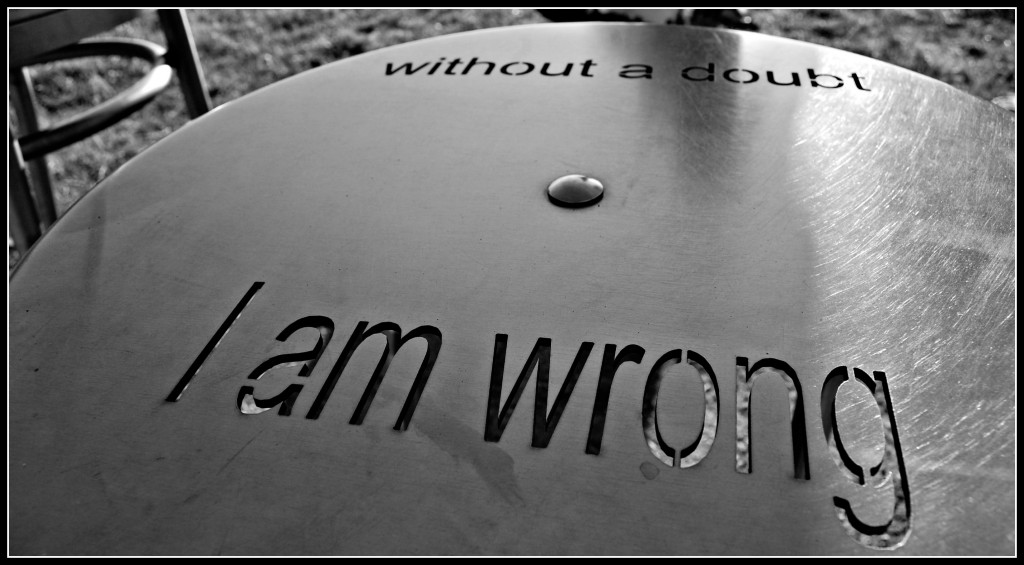
Also a good read might be Edward de Bono's book: I Am Right You Are Wrong: From This to the New Renaissance: From Rock Logic to Water Logic (link to description (Amazon)).
Climate "denial", the media debate and whatnot
This is a guest post by Dr. John Abraham, in response to a Wall Street Journal op-ed by British House of Lords member Matt Ridley. How many climate errors in one article? A recent error-filled opinion piece by Matt Ridley in the Wall Street Journal…
Friday, September 20, 2013
The Huffington post debate: Renewables VS oil, coal and nuclear
I post part of the reply here, as the comments box is too small and I really wanted to give a comprehensive reply (that also shows the limitations of what I know (or think I know)).
The reply is whole as was meant (previous comments will be added in reverse order below later).
I totally agree with your first paragraph. Totally. It does not make any sense to stop all damaging activity (at least not without a magic wand to simultaneously address several problems).
As to the attainability of renewables, I am not so sure. Again, I don’t work in the industry, don’t have the 100% overview on ALL that is happening, but what I can tell you is that a) costs are falling rapidly, b) efficiency is going up (to a certain limit, granted) and c) environmental impact varies from tech to tech, but is generally considered lower than that of fossil fuel industry, coal and nuclear power plants. I give examples and quotes in the next reply.
I don’t feel capable on commenting on the case you build for nuclear, as I did no research in that field. As I understood, we’re not near fusion yet and fission creates waste (that to me, again, in the long run, is not sustainable. Unless we haul it into space (unethical? boomerang?, space debris).
I fully agree that wind and PV have intermittency problems, however, as you partly point out, sun does not shine ON ALL SIDES of the planet at once. With a global network, ... well, with other sources added (wind can operate at night), we can go pretty high in terms of energy self (local)-reliability.
Thanks for explaining the “Long Beach oil” and the purity of it, energy needed to purify it. Makes it more clear now. Thanks!
.
.
.
.
Costs
“Solar technology costs are falling rapidly. Chrystalline silicon PV module costs fell by 70 per cent 2008-January 2012 and are forecast to fall by another 30 per cent by 2015, without subsidies” (Assadourian et al., 2013: Loc 2067).
Energy demand estimates ... and meeting it with renewables
‘Estimates of energy required to meet the world’s continuously growing energy demand vary, and future energy use scenarios vary greatly in their outcomes. A medium scenario examined by European Union foresees doubling of current energy demand by 2050’ [“current” was 13.2 TW in 2011? and is 14 TW in 2012] (EC, 2006; Assadourian et al., 2013).
‘Instead of raising the number of nuclear power plants worldwide from 61 to 1200, based on the immense power that is radiated daily to Earth from the Sun (i.e., 5000 times the estimated requirements for 2050), if we could cover 1 % of the Earth’s land surface with solar panels operating at 10% efficiency, a rough estimate is photovoltaic power could generate around 25 TW’ (Peter, 2011).
Problem is, as Peter (2011) points out, the availability of minerals. For example, cadmium (Cd) for the CdTe solar cells, to meet this demand, one would require amount of Cd for a factor of a 100 exceeding the identified world reserves (Peter, 2011; 3). But, new ways and new cells are underway (for more, see Peter, 2011).
As to the environmental impact of Cadmium (from PV panels production) and other renewables, see Assadourian et al. (2013): they maintain (based on a number of sources) that renewables have lesser impact in total than fossil, though I would exclude biomass from it, as it appears to be the most unsustainable of the crowd.
And about meeting the energy demand in 2050, Assadourian et al. write: “Even with greatly limiting the areas for solar energy development /.../, the potential capacities are estimated at 340 terawatts (TW) for PV and 240 TW for CSP [concentrating solar power systems] – much more than projections for energy demand in 2050, even without any efficiency measures” (2013: Loc 2067).
Locally produced energy (which, granted, needs some more development and changes to the energy grids and distribution)
Another argument in favour of locally produced, renewable energy is (so I read) that of avoiding transmission and distribution costs. Renewable energy sources (e.g., wind, solar, small hydro, wave, and tidal energy), though having different impacts on the environment themselves (also in the book), “have the additional efficiency advantage of converting natural flows of mechanical energy or sunlight directly into electricity, unlike fossil fuel combustion and nuclear power, which require inherently inefficient thermal energy conversion processes.” (Assadourian et al., 2013: Loc 2053, link below).
From an abstract of a book titled Renewable revolution: low carbon energy by 2030 (Sawin & Moomaw, 2009):
Global energy scenarios offer wide-ranging estimates of how much energy renewable sources can contribute, and how quickly this can happen. Many scenarios show a gradual shift to renewables that still envisions a major role for fossil fuels for most of this century. This report examines the potential for renewable energy to provide needed energy services for all societies while lowering heattrapping emissions of greenhouse gases. It concludes that it is not only possible but also essential to effect a massive transformation of the global energy system from its current fossil fuel base between now and 2030 that continues for the rest of the century.
Carbon free?
Photovoltaic cells and panels have a CO2 release of one fifth of that of an average emission rate of conventional fossil fuel-generated electricity. This was calculated for DSCs, with a premise of an efficiency of 8 per cent and lifespan of 5 years, but the number grows even five times smaller for CdTe PV modules (Peter, 2011). Therefore, though not ‘carbon free’, the carbon of PV panels is small enough that a large scale implementation of PV can substantially provide for the world’s energy needs and at the same time addressing some of the problems of climate change (Elliston et al., 2013; Peter, 2011).
References
Assadourian, E., Prugh, T., Adamson, R., & Starke, L. (2013). State of the world 2013: is sustainability still possible?. Washington, DC [etc.]: Island Press.
(Assadourian et al., 2013: Loc 2053 : https://kindle.amazon.com/post/Sdj9B8pvQ-C70-q3GkZt0Q).
EC (2006). European Commission: World energy technology outlook 2050: WETO-H2. See
ftp://ftp.cordis.europa.eu/pub/fp7/energy/docs/weto-h2_en.pdf.
Elliston, B., Macgill, I., & Diesendorf, M. (2013). Least cost 100% renewable electricity scenarios in the Australian National Electricity Market. Energy Policy [In press]. DOI: 10.1016/j.enpol.2013.03.038.
Peter, L. M. (2011). Towards sustainable photovoltaics: the search for new materials. Philosophical Transactions of the Royal Society A: Mathematical, Physical and Engineering Sciences, 369 (1942), 1840-1856.
Sawin, J. L., & Moomaw, W. R. (2009). Renewable revolution: low carbon energy by 2030. Worldwatch Institute.) Link: http://www.cabdirect.org/abstracts/20103141191.html;jsessionid=623D63DEC4D6A3DFBDF201E7C4390340?freeview=true
Thursday, September 19, 2013
Challenge the world faces “today”, September 2013
I write about it extensively in the last weeks, as I’ve come to realisation that discussing* how much the world is warming up, and if it’s at all caused by humans, is IRRELEVANT. The climate debate aside, human society and production systems have such a great impact on the planet, that we’ve practically begun to terraform-it. As it was written before, human society has “become a geological force to reckon with”, thus, the term ‘anthropocene’ some people are giving the current era (See the Economist (2)).
Gist: we need to change. And change is hard. But necessary. Otherwise, the planet (so not the garden, not the local shop, not your country or the continent you are living on, but the PLANET will not be able to take it. And come ecosystems collapse, mass extinctions and decades of economic, cultural and other stagnation of human society. See below.
"The Cost of Ecological Overspending
Throughout most of history, humanity has used nature’s resources to build cities and roads, to provide food and create products, and to absorb our carbon dioxide at a rate that was well within Earth’s budget. But in the mid-1970s, we crossed a critical threshold: Human consumption began outstripping what the planet could reproduce." (1)
* [Referring to the IPCC AR5 media pomp, at the time of writing, yet to come.]
(1) See more: http://www.footprintnetwork.org/en/index.php/gfn/page/earth_overshoot_day/
(2): The Economist: The geology of the planet. Welcome to the Anthropocene. (May 26th 2011 |From the print edition):: http://www.economist.com/node/18744401
Wednesday, September 18, 2013
Climate Change: Debate, Science or Outdated mastodonts?
[It's about] Social and economic change towards a new future. The young always complain about the old (but maybe quietly), the old about the young. But in the case of transition to the new world economy and arrangement, one must be at least willing to transcend some of the old views and values.
As to the Climate science: I'm NOT a climatologist, nor a meteorologist, geologist, physicist, mathematician or geo-chemist. Unless you yourself are, there's a chance we both don't understand ALL the science and data, all the models behind the whole climate change schabang. But we might be both concerned about the future of the (ONE!) planet we have ... and the environmental degradation we ARE causing and strain we ARE putting on the natural system.
I think - no, I know - there are limits to how much people - who consume a given amount of resources and energy, and produce a accompanying waste - there can be on this planet. And I am pretty sure about our survival depending on the ecosystem services, who in turn depend on the working ecosystems, of which various life forms are a big part (and that's an understatement).
So, is climate changing? It appears so. Are anthropogenic emissions a driving cause of it? I am not so sure anymore, but neither do I care - for the moment. But I do care of the equitable production, sustainable living (in cities and elsewhere), minimizing waste, increasing efficiency and _decreasing_ energy use, as well as making sure we don't poison our food, air and water.
You know, survive with a smile, that sort of thing.
Climate Change: Debate, Science or Outdated mastodonts?
Get it here: https://www.facebook.com/aljaz.gabersek/media_set?set=a.10151564622597644.1073741837.563837643&type=3
Saturday, September 14, 2013
Re-usable, re-constructible phone - Phonebloks
A good idea for a way to eliminate excessive electronic waste. Alas, still some way to go to the actual realisation and marketable product.
Luckily, in the meantime, here's the Fairphone, 'A seriously cool smartphone that puts social values first'. It's as sustainable as it gets at the moment. Or it tries to be, and that is a lot.
See why it’s fair and Technical specifications > on the page here: Fairphone.
Friday, September 6, 2013
World Overshoot Day and Global Environmental Footprint network
When we hear: UN/World Bank population projection for 2020 ... 2030 ... 2050 is some bilion, we don't really think of it in terms of how much can I consume in 2050? How much can other consume, if I consume this per cent of the planet's resources. No, we don't as ourselves this, because we've been trained by the media and advertising (Relax... and shop, shop to relax, live better: consume more!), from politicians (We will fix this in our mandate! (If you vote for us.)) and each other (Meh, I'm just one guy and our neighbourhood doesn't even separate waste!). We've been trained that everything is going to be just fine. Well, I'm not so sure about that. Maybe it's going to be sort-of fine for Europe, Japan, USA and Canada, but what happens when 20 million people suddenly want to move their homes, because their homeland has been made unlivable? What happens to Australia with rising temperatures and increased precipitation abnormalities?
I foresee some strife.
And I look at the world and I wonder: why don't people start running down the streets in utter panic, when they hear about stuff like this? Obviously, we discount the value of the future; we put today before tomorrow. But that's the basic animal need and instict. We're better than that, we should be better than that! If the loss of life (err... massive extinctions of other species) dosen't convince us, maybe an economic logic should.
If we make the planet unlivable, where do we live? Surely, number of people still entertaining the notion of just reaching for the stars - flying away (where?) on a spaceship is incredibly small. Right? I mean, we can't simulate the ecological system in a controlled environment, never mind have the means and energy to produce food for so much (how much) people that would embark on the Noah's Ark 2050XYZ. I mean, yes, a laboratory produced burger today costs $332,000 (or just about € 250,000) and it will probably cost less in 2050, but ... do we really want to risk it like that? Risk the lives of your kids, your sister's kids, cousin's kids, your own life, as the date is just 37 years away. God, never thought I'd have to make sure to be in shape at the age of 65 to be able to run onto a spaceship.
Wednesday, September 4, 2013
Emissions in 2020 and 2030
be realistic. One can see in these figures the potential intensity of the debate on who does what and where and how investment and technology are financed."
From: Ethics, equity and the economics of climate change. Nicholas Stern, August 2012. Centre for Climate Change Economics and Policy. Working Paper No. 97, Grantham Research Institute on Climate Change and the Environment Working Paper No. 84. Available at: http://www.lse.ac.uk/GranthamInstitute/publications/WorkingPapers/Papers/80-89/WP84-ethics-equity-economics-of-climate-change.pdf. Last accessed: 4.9.2013.
Dear Prime Minister, please show your shale gas working
"It's not the embarrassing question about why you said communities affected by fracking will get payments of £1m, when you obviously meant £100,000. Your office has already corrected the error and we'll assume it was a case of mis-speaking rather than a deliberate attempt to overstate the benefits.
"It's not the politically tricky question about why you said you "don't think we're going to have a huge amount more" wind turbines, when your government's energy strategy calls for quite a lot more. We'll leave it to your Lib Dem colleagues to ask that one.
/.../
"No, the question I'd really like answered is why you think fracking will lead to "cheaper" energy bills? Have you got some evidence to support this suggestion? Because if so it would really help your case if you shared it.
To be precise, you said: "I think we would be making a big mistake as a nation if we did not think hard about how to encourage fracking and cheaper prices right here in the UK. If you look at what's happening in America with the advent of shale gas and fracking, their energy costs in business and their gas prices are half the level of ours... The EU has about three-quarters as much shale gas as the US, so we are missing out big time at the moment and I want to make sure that Britain does not miss out."
Now I presume you meant to imply that encouraging fracking would lead to cheaper prices, because that is certainly the way the comments have been reported (if that was not the meaning you should probably seek to correct it pretty sharpish). Assuming that is the case, would it be possible to explain how this will work? Because there are plenty of people, including many in the gas industry, who are deeply sceptical fracking in the UK can lead to lower bills."
Read more here, if you want, because it's interesting.