Showing posts with label OUR plaNET. Show all posts

Monday, May 12, 2014

Turn it off.


I totally get this guy (picture).

On a more cereals note, there are soooo many ways to save energy, it's almost ridiculous.
I get that utility companies and energy companies provide jobs for some people and (huge) profits for others, but the thing is, do we REALLY need to keep increasing everything, as that old paradigm goes?

Where does it end? In the previous paradigm (which will not last, as it is self-destructive, and life in general isn't, so there you go), faster, better stronger was the norm. More profit. More stuff. More users.

On a finite planet? Oh, please. I should think enough people get the basic geometry of a sphere or, even simpler, a square. (Or checkboard, if you like.) When you fill it ALL UP, there's nowhere to go.

So how, I ask, can people naively think, that the companies/governments/individuals can compete and keep trying to outcompete each other? The faster they (we) do it, the faster we approach the limit.

Sadly, but also, luckily, the limit of the living (and non-living, physical) environment cannot be pushed. Sadly, and luckily, once we hit that slope downward, mmmm, it's going to be hard to stop the Runaway Train. Why? Because nature works in cycles and because we DO know of the positive (/negative) feedback loops.

It's like taking more drugs or medicines. In one day. You can take as much as you like. Low dose, you'll survive. Extreme overdose, you'll die. Just-over-the-limit-of-your-body dose, you'll die as well. (Without serious medical intervention.)

Because you see, I personally don't know many species or people or galactic creatures that I could call with Galax-Skype and say: "HEY, OUR PLANET GOT AN OVERDOSE. COULD YOU, UM ... COULD YOU COME AND FIX IT FOR US?"

So yeah.
Love your loved ones. And teach them to turn off the lights.
Use the bike. Eat meat and soybean a few times less per year. Do what you can.

And maybe, if enough of us do it, we make it.
Or maybe, there will be a tipping point in public opinion and push for legislators and politicians for a bigger change.

Remember, a single grain of rice can tip the scale. [Emperor in Disney's Mulan]

Got the picture from FB post, here.

Sunday, September 22, 2013

5 questions to help you spot inadequate (false?) climate-related reporting

When you read any news in the media (TV usually gives an even shallow-er overview), be sure to watch out for issues the below 5 questions point out to:
  1. who is the author of the claim and what his professional qualifications are (if it only says PhD or Dr., that doesn't mean the person is a climate scientist, a physicist, has extensive knowledge of meteorology, biology, ecology, is an environmental scientist or anything. And yes, sometimes, people not from these fields of science get called upon to give statements..)
  2. is the person citing specific scientific research or giving a 'general' claim, pointing to a myth, repetition of "what we all know" (but not really, as most of us are not scientists in the particular fields mentioned above)?  *
  3. is this specific research even linked to, referenced in the media item?
    (If not ... it means you might have to do additional research, before you could competently decide on the claims in the news item. Additional time that not many will take...)
  4. If you know or can figure out: who owns the particular media you are getting the news from;
  5. and affiliations of the owner, as well as the author of the claims to the money structures. (Looks specifically for fossil fuel industry and also for UN and government institutions, to be a bit more unbiased.)

With the above questions answered, you should be able to make a pretty good judgement as to whether the article/item in question is sound news reporting, is based on more than just speculation or belief, and whether any partial interests might have influenced it. [Unless you devote your entire week to it, you probably won't get a resounding yes! either way, but a better picture, get you will. [Yoda voice]]

*You can spice-up solving of question 2 by asking yourself, whether the title of the news item is a pompous one (though this can just point to the "sensationalism" in media nowadays) - and are the statements and claims made by the person(s) advocated in the news item also pompous and exaggerated or are they more moderate? **

** Note that as denial and attacks on persons and institutions involved in the climate science in the last couple of years intensified, so did the reporting from some of the scientists. From being moderate, even timid at first, quite some of them apparently decided it's time for more decisive "action" and stronger words, that should somewhat balance the otherwise pompous and screaming climate "denialism".

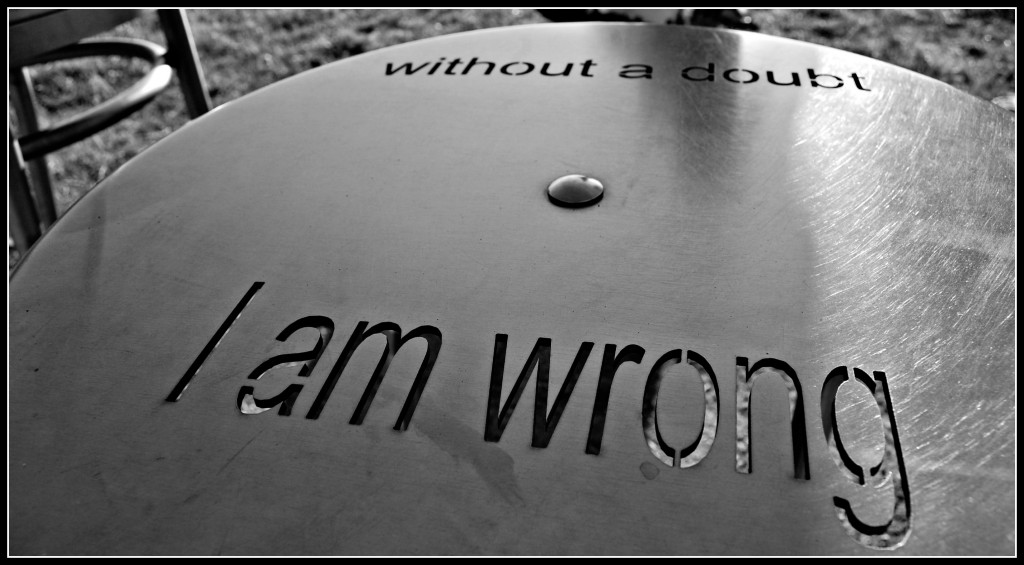
Also a good read might be Edward de Bono's book: I Am Right You Are Wrong: From This to the New Renaissance: From Rock Logic to Water Logic (link to description (Amazon)).

Thursday, September 19, 2013

Challenge the world faces “today”, September 2013

Challenge the world faces “today”, September 2013, is whether climate warming “denialists” and “contrarians”, as well as PR people from the fossil fuel industry will be able to convince everybody else that IPCC was wrong, UN was wrong and that we don’t need to act, to change our way of living. And that is a dead wrong perception.
  I write about it extensively in the last weeks, as I’ve come to realisation that discussing* how much the world is warming up, and if it’s at all caused by humans, is IRRELEVANT. The climate debate aside, human society and production systems have such a great impact on the planet, that we’ve practically begun to terraform-it. As it was written before, human society has “become a geological force to reckon with”, thus, the term ‘anthropocene’ some people are giving the current era (See the Economist (2)).

Gist: we need to change. And change is hard. But necessary. Otherwise, the planet (so not the garden, not the local shop, not your country or the continent you are living on, but the PLANET will not be able to take it. And come ecosystems collapse, mass extinctions and decades of economic, cultural and other stagnation of human society. See below.

"The Cost of Ecological Overspending

Throughout most of history, humanity has used nature’s resources to build cities and roads, to provide food and create products, and to absorb our carbon dioxide at a rate that was well within Earth’s budget. But in the mid-1970s, we crossed a critical threshold: Human consumption began outstripping what the planet could reproduce." (1)


* [Referring to the IPCC AR5 media pomp, at the time of writing, yet to come.]
(1) See more: http://www.footprintnetwork.org/en/index.php/gfn/page/earth_overshoot_day/

(2): The Economist: The geology of the planet. Welcome to the Anthropocene. (May 26th 2011 |From the print edition):: http://www.economist.com/node/18744401

Saturday, September 14, 2013

Re-usable, re-constructible phone - Phonebloks

[Buzz of the week] A phone only lasts a couple of years before it breaks or becomes obsolete. Although it's often just one part which killed it we throw everything away since it's almost impossible to repair or upgrade. Visit www.phonebloks.com to show your support and raise your voice. via:


A good idea for a way to eliminate excessive electronic waste. Alas, still some way to go to the actual realisation and marketable product.

Luckily, in the meantime, here's the Fairphone, 'A seriously cool smartphone that puts social values first'. It's as sustainable as it gets at the moment. Or it tries to be, and that is a lot.
See why it’s fair and Technical specifications > on the page here: Fairphone.

Friday, May 24, 2013

What if it's all a big hoax, climate cover-up and Kunt Vonnegut

What if we create a better world for nothing?

 An interesting read has been brought to my attention recently: Climate Cover-Up by James Hoggan.
"Climate Cover-Up names names, identifying bogus experts who are actually paid lobbyists and flaks. The authors reveal the pr techniques used to misinform, to mangle the language, and to intimidate the media into maintaining a phony climate change debate."...


 It is amazing, how many people continue to argue about it. I for one think it does not matter - we can just dispense with the climate change talk ... and try to deal with the rest of the shit. Inequality, corruption and environmental degradation, with a topping of species loss per day and riots because of too few owning too much. Well, but we've been there, haven't we? We did squat. Sooo, luckily for the planet and ALL its species (including us, humans), we'll face a crisis bigger than anything we've seen before. And then, we'll act. Loosing some billion human lives on the way, but we'll act. And I hope we then truly manage the world in a sustainable, custodian-guardian kind of way. Sigh.

I got the Big Hoax picture from the internet search (type in the text in the speech bouble and you will get it), but one for example is this one [the animated cartoon I don't really get in whole, I'm afraid].


Additionally, "what’s so radical about wanting to protect life-sustaining biosystems? About wanting to only consume as much energy and resources as is sustainable? And about wanting to build an economic system that is equitable?
And ‘equitable’ means equitable for all, including future generations
."

From a great Blog post that is designed to 'lift your spirits':
Was Kurt Vonnegut right (and if so, Now What?), by Mike Targett.

Sunday, May 12, 2013

Climate Change Summit 2040, To be held on Mount Everest

 
Will say something about this later, but for now:
2012 was the year the Kyoto protocol targets "ran out" (from 2007 - 2012, even though Kyoto was signed in 1997!).
As of now, we DO NOT have a binding international agreement ... not until 2015, when they will try to form another one.
... Which will ENTER in force probably in 2017 or as late as 2020.

... Can you see how ever increasing GHG emissions and environmental degradation, WHILE we talk and quibble (/squabble) about how best to do it will hinder us in the very goals we are trying to achieve?

Mind, there has been an increasing number of studies stating that the 2 degrees target* for the 2050/2100 will be increasingly harder to meet, since we're all going berserk and trying to race each-other in the unsustainable economy. They say that if the most strict emission abatements/reductions were applied by the developed AND developing countries, MAYBE we would JUST achieve the 2 degrees target.

I don't know how much you know about the planetary ecosystem resilience ... I know only enough to know I haven't got a clue. But I do "know" that it's going to be increasingly harder to survive.

See also my blog with many more links (interspersed with some rants, granted): http://aljobaljoenvironmental.blogspot.nl/

The photo is from The Economist, from Kal Cartoons (link also here), though I originally got it from a blog, here. Ha, I used in my MSc thesis presentation. You know, as the classical "end humour" photo.

Friday, May 10, 2013

Tar sands and coal shale is us being junkies

Junkies find veins in their toes when the ones in their arms and their legs collapse.
Developping tar sands and coal shale is the equivalent.

-- http://www.ted.com/playlists/78/climate_change_oh_it_s_real.html

Meanwhile, Canada is considering bypassing the beleaguered Keystone XL pipeline (which would carry oil from tar sands deposits in Alberta to the US and the Gulf of Mexico) by shipping across the Arctic Ocean instead. <link>
 
Bill McKibben @billmckibben writes today:
Amazon could lose two-thirds of its biomass by 2060? Not really great news http://wwwp.dailyclimate.org/tdc-newsroom/2013/05/amazon-deforestation …
This is where we, the average consumers step in. Can you spot the link?:
Brazil is under intense pressure to convert the Amazon forests to produce crops and provide pasture for cattle. But the forests' natural ecosystems sustain wild food production, maintain water and other resources, regulate climate and air quality and ameliorate the impact of infectious diseases. 
They predict that by 2050 a decrease in precipitation caused by deforestation will reduce pasture productivity by 30 percent in the governance scenario and by 34 percent in the business-as-usual scenario. They say increasing temperatures could cause a reduction in soybean yield by 24 percent in the governance scenario and by 28 percent under the business-as-usual scenario.
I used to think that "war-like-mobilisation" to combat #climatechange propagated by @paulgilding was a bit excessive. Now I think he's right. <link>
@paulgilding Referring to the implications of 'Two scenarios' in the article: Amazon -65% by 2060
http://wwwp.dailyclimate.org/tdc-newsroom/2013/05/amazon-deforestation … via @billmckibben


Renewable energy 'soaring' in Australia as carbon price does what it's supposed to (Carbon price working? Coal slumps, clean energy soars <link>)
Electricity generated by Australia's highly polluting brown coal power plants has fallen 14 per cent since introduction of the carbon price, while renewable power has soared.
/.../ All up, the emissions intensity of the national electricity market has fallen 5.4 per cent since the carbon price was introduced, meaning carbon emissions from power generation is down 7.7 per cent, or 10 million tonnes, from the previous nine months.

The Dem base--even its big donors--are in a real uproar over Keystone. As they should be--it's a fateful decision http://www.washingtonpost.com/blogs/post-politics/wp/2013/05/10/activists-compare-keystone-decision-to-lincolns-outlawing-of-slavery/ …
 
 
 Carbon price working? Coal slumps, clean energy soars

Just a test on how this displays:
<blockquote class="twitter-tweet"><p>Amazon could lose two-thirds of its biomass by 2060? Not really great news<a href="http://t.co/1XLOevqH0R" title="http://wwwp.dailyclimate.org/tdc-newsroom/2013/05/amazon-deforestation">wwwp.dailyclimate.org/tdc-newsroom/2…</a></p>&mdash; Bill McKibben (@billmckibben) <a href="https://twitter.com/billmckibben/status/332867369540128768">May 10, 2013</a></blockquote>
<script async src="//platform.twitter.com/widgets.js" charset="utf-8"></script>


Friday, April 26, 2013

Divestment movement, New York Times, Bill McKibben, Do the Math

It's time to post some of a more positive outlook. Ever heard of the Divestment movement?

Well, it just so happens that this interview with Bill McKibben (350.org; fathered projects like Connect the Dots, Do the Math) explains it well and cites some influential media in doing so:


"The New York Times, in what became the week's most e-mailed story in the paper of record, said the campaign could "force climate change back on to the nation's political agenda." A few days later, Time magazine ended its account of the mushrooming movement like this: "University presidents who don't fall in line should get used to hearing protests outside their offices. Just like their forerunners in the apartheid battles of the 1980s, these climate activists won't stop until they win.""

You might be interested to read more, here: Divest from Fossil Fuels. Now. (By Bill McKibben)

Thursday, April 18, 2013

Rise of Climate Refugees: Nowhere to turn


From a blog, describing the life and situation of <climate> refugees in Nairobi/Kenya.

  Both Teddy and Admassu were born in Ethiopia and forced to flee their homes. Teddy left after he and his father were tortured by the current regime for handing out human rights leaflets. He fits the standard definition of refugee, having fled his country’s trenchant political persecution. But for Admassu, who left Ethiopia’s desiccating landscape, things are more complicated. If there were such a thing as an environmental refugee, Admassu, along with hundreds of thousands of others around the globe, would be one—but there is simply no such thing.

A refugee is a person who flees persecution based on his or her race, religion, political opinion, nationality, or membership in a particular social group. This is the definition the international community coined in “never again” spirit in the wake of the Holocaust. Currently, Kenya is home to over 600,000 refugees from dozens of neighboring countries: they flee political repression in Ethiopia, protracted conflict in eastern Congo, and, most infamously in recent years, a devastating state failure and wide-spread famine in Somalia. But Kenya is also home to thousands of migrants like Admassu who are not among these protected refugees—nor will they be unless current laws change.

Admassu left the Kambata region of Ethiopia in October of 2011, just two months prior to our meeting, because the changing weather rendered his life, in effect, unlivable. He comes from a long line of farmers in one of Ethiopia’s most fertile regions. But since 2005, Teddy translates, the weather has not been right. “Before five years ago, the weather is better for growing something. This time, it’s not good,” Teddy translates. All the weather patterns Admassu had come to rely on are now bunk. “Nothing grows. It’s very dry.”

From post named Nowhere to Turn, By Lauren Markham, on April 15, 2013.